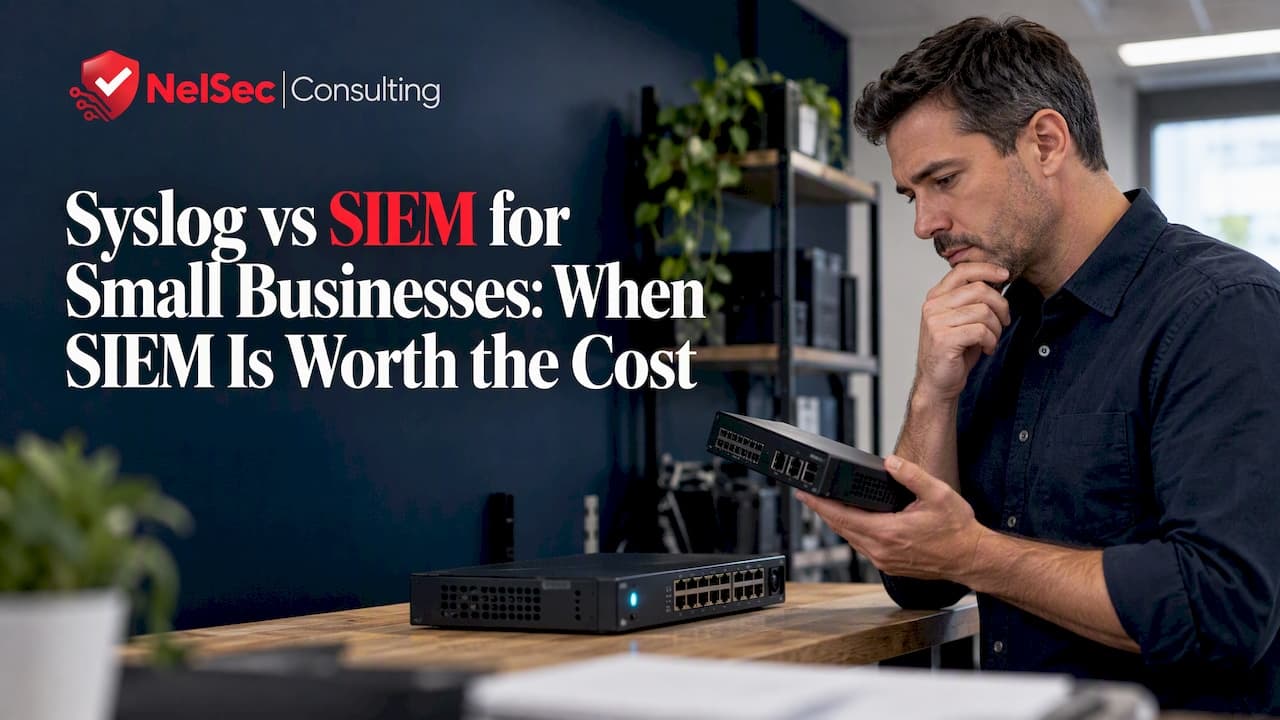
Syslog is a transport and collection protocol that moves log messages from devices to a central point. SIEM is a platform that ingests those messages, correlates them with other data, and flags threats for investigation. They are complementary, not competing, tools: syslog is often the delivery mechanism, SIEM is the brain. Standards from the Rfc-editor define how the former works, and our team at NelSec Consulting advises small organizations on when the latter becomes worth the investment.
TL;DR:
- UDP can silently drop messages during congestion; use TLS for authentication events or sensitive application data, and size disk queues to cover downstream outages.
- A small environment with a handful of servers, no audit requirement, and only troubleshooting or uptime needs can begin with centralized syslog alone.
- Add SIEM when you need real time threat detection, cross system correlation, audit evidence, or incident timelines spanning firewalls, servers, and endpoints.
- Estimate daily event volume before setting a retention period, because ingest drives storage costs more than device count; align storage duration with compliance requirements.
Table of Contents
- How syslog works as a transport and collection layer
- What a SIEM platform actually does
- Syslog vs SIEM: what each is built to optimize
- How syslog and SIEM fit together in one pipeline
- 1. When syslog alone is enough, and when you need SIEM
- Planning for scale, retention, and cost
- A practical checklist for small businesses and nonprofits
- How we help with logging and SIEM planning
- FAQ
- Sources
How syslog works as a transport and collection layer
Syslog separates three concerns: message content, application behavior, and transport. RFC 5424 formalized this layered architecture along with a structured message format that includes a timestamp, severity, facility code, and hostname, so any receiving system can parse a message the same way regardless of the sending device.
Messages travel over one of a few transports. UDP is lightweight and common for low-stakes internal logging, but it drops packets silently when a link is congested. TCP adds reliability. For anything touching sensitive systems, TLS is the better choice: RFC 5425 defines syslog over TLS specifically to guard against masquerade, tampering, and disclosure of log contents in transit, and RFC 9662 updates the recommended cipher suites to favor options with forward secrecy.
On the collection side, most environments run an agent on each source system and forward to a central collector. Common building blocks include:
- Lightweight agents on servers and network gear that generate and forward syslog messages.
- Central collectors, often built on implementations like rsyslog, that receive, filter, and route messages.
- Disk-backed queues on the collector that hold messages temporarily if a downstream destination goes offline.
- Rate limiting and selectors that let administrators filter by facility and severity before messages ever reach storage.
Pro Tip: Set your collector's disk queue large enough to survive an outage of your downstream storage or SIEM, otherwise a routine maintenance window turns into a silent gap in your log history.
What a SIEM platform actually does
Syslog get messages from point A to point B. A SIEM platform does the analytical work on top of that data. Gartner defines Security Information and Event Management as a platform that centralizes security-related logs and events, then applies correlation rules, analytics, and workflows to detect threats, generate real-time alerts, and support both investigation and compliance reporting.
Syslog is frequently one of several ingestion paths into that platform, alongside API-based collectors, cloud service logs, and endpoint telemetry. Once data lands inside the platform, it gets normalized into a common schema, enriched with context like asset ownership or threat intelligence, and matched against correlation rules that look for patterns a single log line would never reveal on its own, like a failed login on one system followed by a successful login on another from the same account.
The outputs are what separate a SIEM from a plain log repository:
- Real-time alerts when correlation rules match a suspicious pattern.
- Dashboards that give security teams a live view of activity across the environment.
- Forensic search that lets investigators reconstruct an incident timeline across every ingested source.
- Compliance reports formatted for the audits a given industry requires.
A platform-level definition matters here, because Gartner's own glossary describes SIEM as a category built specifically around correlation and workflow, capabilities that a syslog server alone was never designed to provide.
Syslog vs SIEM: what each is built to optimize
The clearest way to see the difference is to line the two up against the jobs they actually do. Syslog excels at reliable, standardized transport. A SIEM platform excels at making sense of what arrives.
- Primary function: syslog moves and collects messages; SIEM analyzes and correlates them.
- Data processing: syslog does light filtering and formatting; SIEM performs parsing, normalization, and enrichment against context like asset or user data.
- Threat detection and correlation: syslog has none built in; SIEM correlates across sources to surface patterns a single log can't show.
- Alerting and response: syslog can trigger basic forwarding rules; SIEM generates prioritized, real-time alerts tied to investigation workflows.
- Storage and retention: syslog servers retain raw messages for as long as disk allows; SIEM platforms typically manage tiered retention aligned to compliance windows.
- Deployment complexity and cost: a syslog server is simple to stand up and cheap to run; a SIEM platform requires more planning, licensing, and ongoing tuning.
- Compliance and reporting: syslog provides raw evidence; SIEM packages that evidence into audit-ready reports.
The lines blur in practice. Entry-level collectors sometimes add basic alerting, and enterprise detection platforms sometimes include their own lightweight collection agents, so the real question is less "which product" and more which jobs your organization needs covered today.
How syslog and SIEM fit together in one pipeline
A typical architecture looks like this: a source system (a firewall, server, or application) generates an event, a local agent formats it as a syslog message, that message travels to a central syslog collector, and the collector forwards it into a SIEM platform for ingestion. Parsing and normalization usually happen at two points: lightly at the collector, where facility and severity get standardized, and more heavily inside the SIEM, where fields get mapped to a common schema for correlation.

Buffering matters more than most teams expect. A collector configured with disk-backed queues, the approach described in practical guides to syslog implementations like rsyslog, keeps messages intact when the downstream SIEM is temporarily unreachable. For anything carrying authentication events or sensitive application data, that transport should run over TLS, following the framing in RFC 5425 and the updated cipher guidance in RFC 9662.
Hybrid environments add a wrinkle. Windows systems often use native Windows Event Forwarding rather than syslog agents, so a mixed Windows and Linux environment typically needs both forwarding mechanisms feeding the same SIEM destination.
Pro Tip: Normalize facility, severity, and timestamps at the collector; save deeper enrichment, like tagging an event with the asset owner or threat intelligence context, for the SIEM, where that context already lives.
1. When syslog alone is enough, and when you need SIEM
Not every organization needs a full SIEM deployment on day one. The decision comes down to scale, compliance obligations, and how much correlation you actually need.
- Syslog alone usually fits a small environment with a handful of servers, no regulatory audit requirement, and a goal limited to basic troubleshooting and uptime history.
- SIEM becomes worth the investment once you need to correlate events across multiple systems, detect threats in real time, or produce evidence for a compliance audit.
- Multi-source forensics (reconstructing what happened across a firewall, a server, and an endpoint during one incident) is a strong SIEM trigger on its own.
- A phased approach works well for most growing organizations: centralize logs with syslog first, confirm retention and reliability are solid, then layer in correlation and alerting once the volume and risk justify it.
That phased path avoids paying for correlation capability before there's enough data flowing to make it useful.
Planning for scale, retention, and cost
Ingest volume drives everything downstream. Before committing to a retention policy, estimate how many events per day your sources generate, since that number determines storage cost far more than the number of devices does.
- Retention should match your actual compliance window, not a default setting, since over-retaining raw logs multiplies storage cost for no benefit.
- Parsing and alert tuning need regular review. Rules can fire noisy alerts at first; tuning them against real traffic helps keep the alert queue usable.
- Budget items worth tracking separately: ingest volume, storage, platform licensing, and the staff time needed to maintain and tune the system.
- Backup and continuity apply to the logging pipeline itself, since losing the only copy of your security evidence during an incident defeats the purpose of collecting it.
A SIEM platform is only as useful as the people tuning it, which is why Gartner's SIEM definition explicitly ties the category to correlation workflows and investigation support, not just raw data storage.
A practical checklist for small businesses and nonprofits
Before buying anything, list every system that should be logged, assign an owner to each, decide how long you need to retain data, and name who gets called during an incident. A solid starting point is centralized syslog over TLS with a conservative retention baseline and a handful of simple alert rules. Consider bringing in outside help once staff bandwidth, audit requirements, or sustained alert fatigue outpace what your team can manage alone.
— Devon
How we help with logging and SIEM planning
We work with small businesses and nonprofits to design logging architectures that fit the budget and the risk, not the other way around. Whether you need a centralized syslog setup with secure transport, help evaluating whether a SIEM makes sense yet, or ongoing monitoring once it's in place, our cybersecurity consulting and network security services cover the full path.

We start every engagement with an initial assessment so you know exactly what you need before spending on a platform you may not be ready for. Reach out through NelSec Consulting to schedule yours and get a clear, jargon-free plan for your logging and monitoring needs.
FAQ
What is Syslog-ng?
Syslog-ng is a widely used implementation of the syslog protocol, similar in role to rsyslog, that collects, filters, and forwards log messages according to the standards defined in RFC 5424. It supports multiple transports, including TLS, for secure delivery to a central collector or SIEM.
Is Microsoft Defender a SIEM tool?
Microsoft Defender is primarily an endpoint detection and response (EDR) product, not a full SIEM platform. It focuses on protecting and monitoring endpoints, while a SIEM centralizes and correlates events across many types of sources, as described in Gartner's SIEM definition.
Is CrowdStrike a SIEM or EDR?
CrowdStrike's core product is an EDR platform built to detect and respond to threats on individual endpoints. Some vendors in this space add SIEM-like features such as broader log correlation, but the foundational capability remains endpoint-focused detection and response rather than organization-wide log correlation.
What is a good syslog server?
A good syslog server reliably receives, filters, and forwards messages, supports TLS transport as defined in RFC 5425, and includes disk-backed queuing so logs survive downstream outages. Implementations like rsyslog are commonly used for this role because they support flexible filtering and secure transport configuration.
Sources
For readers who want the original technical definitions behind this guide: RFC 5424 defines syslog's message format and layered architecture, RFC 5425 specifies TLS transport for syslog, and RFC 9662 updates the recommended cipher suites for secure syslog deployments. Gartner's glossary defines the SIEM category referenced throughout.